
There are so many drugs advertised these days. Everywhere you turn—TV, streaming services, newspapers, magazines, social media platforms. At this time of year, you can’t get away from Medicare “advantage” ads and even more drug ads. Whether you’re watching Big 10 or NFL football games, network TV shows, or Hallmark movies, you’ll suffer through plenty of drug and “advantage” ads. So, you know you’ve entered the “season” to reshop your Medicare Part D plan for 2027.
A big warning for 2027
Big warning from me: It’s crazier than ever in Part D land this year. You should expect to change your Part D insurer for 2027. Otherwise, you could be paying a lot more for your Rxs. One client just told me that, on first pass, her entire Part D bill jumped from just over $1,000 for 2026 to over $3,500 for just one prescription in 2027. The Part D insurer that was most economical for 2026 no longer covers a key drug she needs.
Please keep reading for what’s going on in Medicare Part D plans for 2027. And steps you should take the first week of November.
Let’s take a step back and look at some numbers
Many people I’ve already talked to this fall are unhappy that they need to change their prescription drug coverage. Again. I understand the frustration and the confusion. So let me put these drug plans in some perspective before diving into what’s going on with Part D plans for 2027.
Have you ever thought about how much those advertised drugs cost? Here are few examples that I track each year as I delve into the belly of the prescription drug beast. These are the one-year costs if you don’t end up in the right Part D plan:
- Eliquis – $7,900
- Tresiba (extended insulin) – $8,600
- Dupixent – $55,000
- Xeljanz – $92,300
- Tremfya – $220,244
I can hardly breathe when I see these retail costs. And I worry that some of my clients will not reshop their plans and find themselves in a financial disaster. Please reshop your Part D plan!!
Medicare Part D was created to help seniors pay for Rxs
I start here to show you some of the complexity and craziness of the Medicare Part D program. As these modern miracles of medicine became available, the very people they were meant to help couldn’t afford them.
If you had employer-sponsored group health insurance as a worker, you typically had help paying for these gems. But if you were retired and on Medicare, little help was available to cover the costs. Who has $55,000 per year to cover their drugs? And even if you do, is this where you want to spend your hard-earned money? Probably not.
So, the Medicare Modernization Act of 2003 added a new section to the law – Medicare Part D. This part was designed to help seniors and others in Medicare get some cost help with expensive drugs. But it didn’t segregate just high-cost drugs. It created an entire pricing infrastructure to lower prescription drug costs for almost everyone.
Beginning in 2006, twenty years ago now, retirees finally had a cost-sharing insurance plan available to help them pay for Rxs. But it was never meant to pay full-freight. You still have to pay something toward your Rxs.
The complex infrastructure
Since Medicare Part D is part of the gigantic Social Security law, it was bound to be complex. And it has not disappointed. Private insurance companies offer Part D plans. Some you’ve heard of (Blue Cross, Humana), others not so much (Wellcare, HealthSpring).
Each insurance company creates its own formulary—the list of specific drugs it decides to help you pay for. No two formularies are alike. No two formularies stay the same from one year to the next.
The next part of the infrastructure is: how will you actually get these drugs? They need to be dispensed through a pharmacy. But which pharmacies have distribution agreements with which Part D insurance companies? That’s an opaque mystery in the dealmaking between companies.
That’s not all. What about the manufacturers? After all, the companies making your drugs need to sell them through the regulated “highways.” Middlemen are in the mix here. Their job is to negotiate the best deals among and between all the players. But not with the consumer’s pocketbook in mind. These are corporate deals to boost stock prices.
Part D plans are 1-year contracts
For retirees, that means finding the right combination of corporate giants for their individual needs. They need to find an insurance company that covers all their Rxs at a local pharmacy for the most economical price. And every year, all the players change their offerings and who they play with in their sandbox. What could possibly go wrong here?
Start with the fact that your Part D plan is a 1-year agreement. Every Part D plan runs from January 1 – December 31. You can only enter mid-year when you first enter Medicare.
Meanwhile, drug manufacturers, Part D insurance companies, pharmacies, and CMS are negotiating deals for the following year. During these months, anything and everything can change. And it does. This is what they mean when they say Part D plans are 1-year contracts.
And that’s why your Medicare Part D plan for 2027 will be different than the Part D plan you bought in 2026. Even though you didn’t make any changes to your prescriptions.
Fewer Part D plans for 2027…and a dramatic decline in plans offered
I’ve been tracking the shenanigans in Part D plans for several years now. The most disturbing thing is how many insurers have pulled out of the prescription drug business. I can’t decide if it’s simply a matter of profitability or if we should be alarmed.
Take a look at the steep decline in Part D plan offerings:
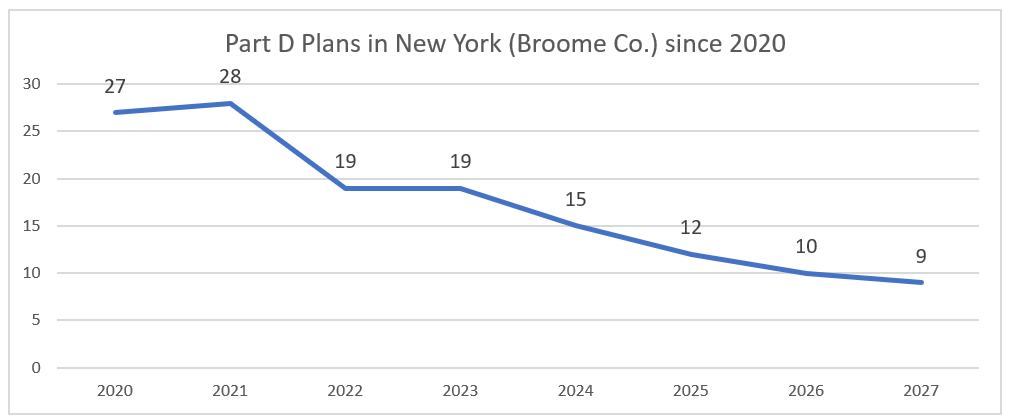
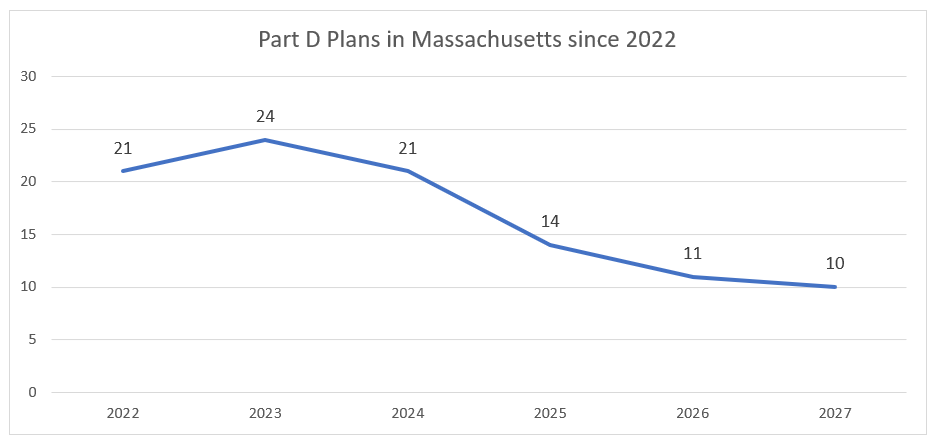
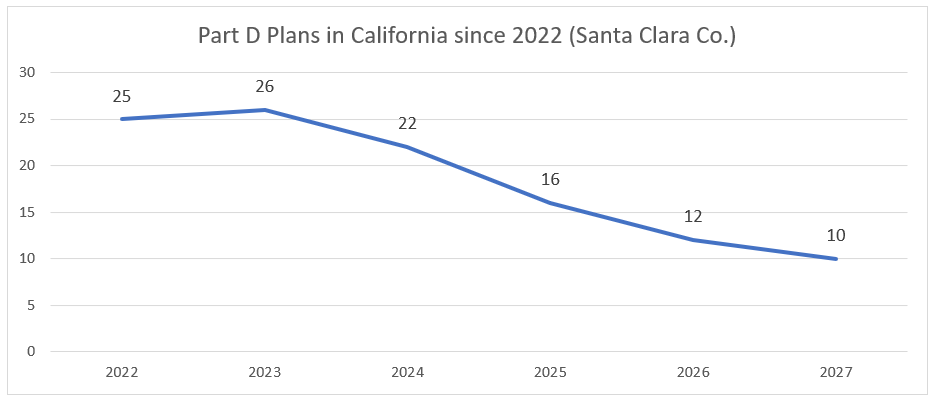
California has seen a 62% drop in the number of Part D plans offered—down to just 10 options for 2027. New York has experienced a 68% drop since its 2023 high—down to 9 Part D plans. Massachusetts is down 58%, with 10 plans in the market.
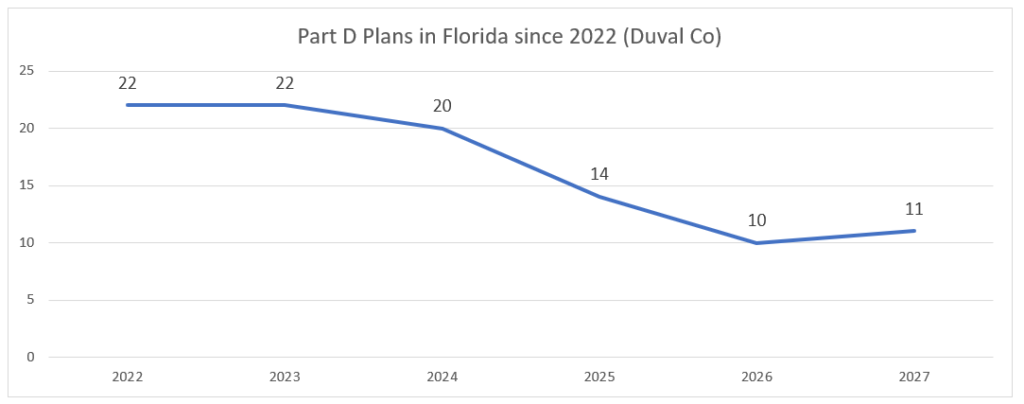
A notable exception is Florida. There is one more Part D plan offered in 2027 than in 2026, bringing the total to 11. Overall, Florida has half as many plans as it did in 2023.
Look carefully to see if your Part D plan for 2027 is still available
If you were in Wellcare or Humana in 2026, your plan may still be offered in 2027. But the premium will likely be higher. And there is no assurance that your prescriptions will still be covered.
It’s critical that you check your situation! Either review the annual notice that should have arrived from your Part D insurance company in late September or early October. Or use the Medicare.gov Plan Finder to check the plans offered in your zip code for 2027.
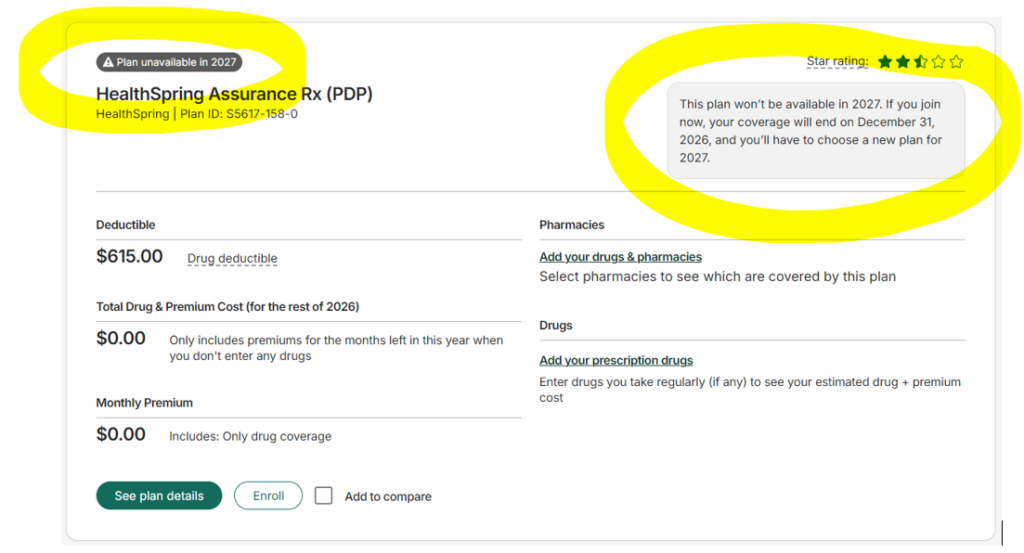
If a plan will no longer be offered, you will see a note in the “Plans for 2026” database (NOT in the 2027 database). Something like this one:
$0 monthly premium Part D plans for 2027 have completely disappeared
Unsurprisingly, most monthly premiums in Part D plans for 2027 have increased. Some by just a dollar or two per month.
A significant, notable change is that all $0 monthly plans offered over the last several years have disappeared entirely. Two years ago, the fifty-cent Wellcare plans disappeared in some New England states. And the lowest Part D plan in New York state jumped from about $3.50 to nearly $35.00 per month. So, we’ve seen this kind of premium rate hike before.
However, it was quite a surprise that every Part D plan with a $0 premium in 2026 hiked its premium to at least $5.30 for 2027. There was no regional rollout of higher prices. Just an across-the-board increase for every retiree.
But remember, Part D plans are only 1-year contracts. Premiums can and do change year to year. This is one pricing lever insurers have to ensure profitability.
What to do if you have a premium increase?
What happens if your current Part D plan shows an increase for 2027? This will be your situation if you had a $0 premium Wellcare Part D plan. Or a low-cost Humana Part D plan in 2026. Well then, it’s time to assess if you need to switch Part D plans for 2027.
Your premium may only increase a dollar or two between 2026 and 2027, so it might not be worth the hassle to change plans. But the latest analysis from KFF shows the average premium has increased 50%. So, if you stay in your same plan in 2027, you may be paying much more than you need to.
Take the time to evaluate your situation. It’s not only the premium that matters. Maybe your premium only increased by $4, but how much have your drug prices changed? Are you sure all your prescriptions are still covered by the plan you chose last year? Is the pharmacy you use in 2026 still an option for 2027?
If you don’t reshop your Part D plan for 2027 before December 7th, you’re stuck with what you have for the next 12 months. Please reshop your Part D plan today!
The annual deductible hit a new high mark in Part D plans for 2027
The annual deductible is the amount you’ll pay out of pocket before the insurer starts to share the cost. For 2027, there is a big jump in how much you must pay before the plan starts to cover some of the cost. The 2027 deductible is $700—a 14% increase over 2026’s $615.
Some people are confused about who pays the deductible. Many folks ask if they have to pay $700 even if their only Rx is a generic with a $0 cost. The answer is no.
You only pay toward this deductible if your Rx comes with a price tag. Most generics are tier 1 drugs with a $0 cost to you. So, you’ll pay nothing toward the deductible. Pay your monthly premium (and any Medicare Part D IRMAA), and your drug cost is $0.
Let’s look at an example for just 1 generic Rx…
As an example, let’s say you only take Atorvastatin—a generic drug to lower cholesterol. In this case, a preferred pharmacy (CVS, Walgreens, and Mail Order) charges $0 for this Rx. So, you pay nothing toward the annual deductible.
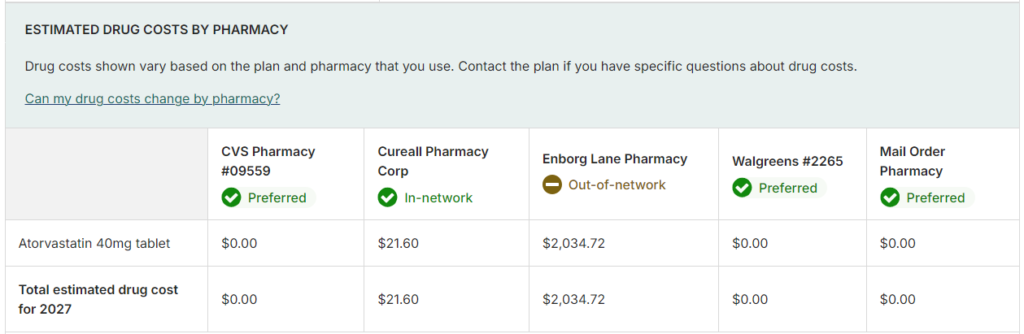
However, if you choose a pharmacy that is only “in-network” (Cureall), you’ll pay a couple of dollars per month. But an out-of-network pharmacy (Enborg Land) does not have a pricing agreement with this Part D plan, so you get no coverage at all. This mistake will cost you over $2,000! For a generic drug.
This example is for someone living in zip code 92125, Santa Clara Co., California. It’s the Wellcare Value Script plan.
…now, add in 1 tier one drug
The same person in this zip code who takes Atorvastatin and Eliquis has a very different pricing situation. Eliquis is a tier 2 drug with a retail price of $7,913. In this case, you first pay the $700 deductible, then pay a lower portion of the cost while Wellcare picks up the rest. But you must choose a preferred or in-network pharmacy.
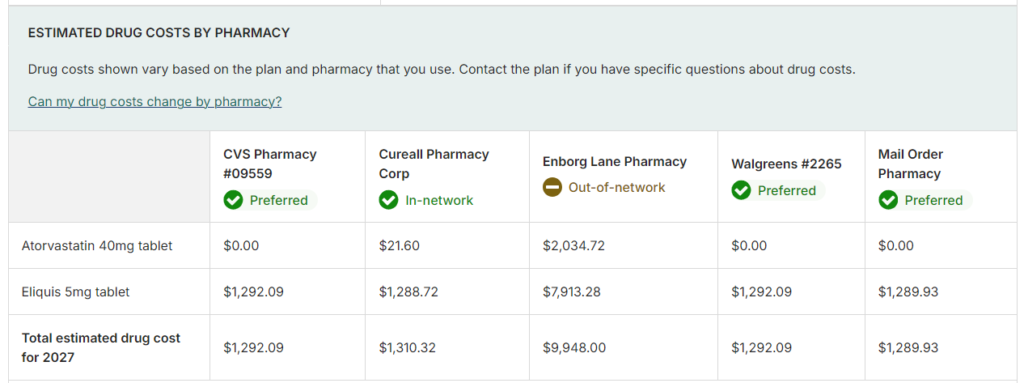
You can see the details of how much they’ll pay by month and when they’d meet the deductible (in March) using the Plan Finder on Medicare.gov:
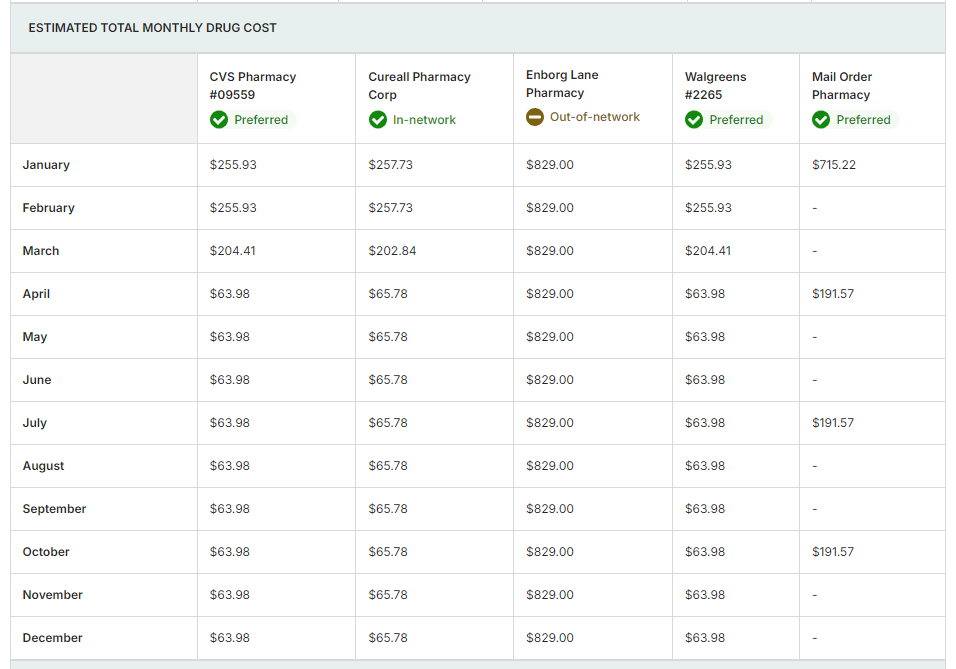
After meeting the deductible, you would only pay 25% of the drug cost. In total, you’d pay $1,292 at CVS. But notice that payments are front-loaded to meet the deductible first.
The bottom line: You only pay toward the $700 deductible if your drugs carry a retail cost to you.
The OOP cap took a big jump up in Part D plans for 2027
You may recall a new law changed how Part D costs were capped for those needing high-cost drugs. Two years ago, the Biden Administration passed the Inflation Reduction Act. The maximum out-of-pocket (OOP) cost a retiree would pay for covered drugs was capped at $2,000. This law also included an indexing feature, meaning the OOP cap would increase each year with inflation.
And here’s where we see another impact due to high inflation. The OOP cap jumped from $2,100 in 2026 to $2,400 in 2027. That’s a whopping 14% increase in just one year!
Retirees with high-cost drugs like Dupixent will be hit by this cap. Paying $2,400 instead of $55,000 seems like a pretty good deal. But it’s still a steep jump in costs if you fall into this category.
Steps to take to reshop your Medicare Part D plan for 2027
Hopefully, it won’t take more than a half hour to an hour to reshop your Part D plan and enroll in a new plan if needed. You have two paths to take:
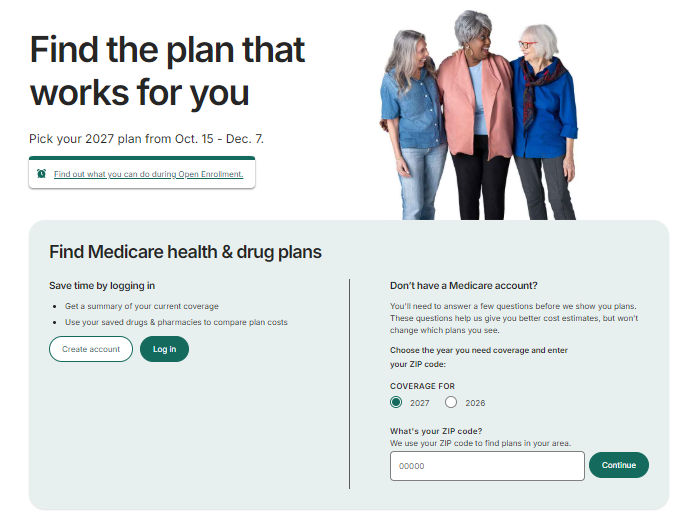
1) Go to the Medicare Plan Finder on Medicare.gov. Log in to your online Medicare account (or create a new account) and review your existing prescriptions.
- Make any changes necessary—add new Rxs, delete ones you no longer take. Double-check the dosage amount and quantity you take.
- Check 5 pharmacies to include in your comparison shop. I always recommend you choose mail order, CVS, Walgreens, and 2 others. You can’t tell by looking which pharmacy is going to have a preferred arrangement with each Part D insurer.
- Look at the results. There will only be 1 best option—the most economical combination of monthly premium + cost of your specific Rxs.
- If the answer is to get a new plan, go to the new Part D insurer’s website to enroll. If you decide to keep your current plan, you don’t need to do anything. Just make sure you pay your premiums to the Part D insurer, and your plan will continue for 2027.
Another excellent option
2) Sign up for HeyMOE! This online subscription service compares all your options. It’s $30 per year per person. You simply enter your Rxs and zip code, and you’ll get a report. I strongly recommend HeyMOE if you hate the bother of this reshopping every year. Plus, the owners are wonderful and have created a great online program.
I wrote more details about the HeyMOE service in my Part D post last year. You might want to reread it if you have some time.
- If you signed up last year, you automatically received your new plan options for 2027 on or around October 15th.
- The service proactively reaches out to you with your next year’s options, so you don’t have to remember to do it. But once you get the HeyMOE emails, you do need to double-check your Rxs. Make sure you haven’t missed anything.
A few last-minute notes and insights
If you have a Medicare “advantage” plan.
This is a particularly bad year if you chose a Medicare “advantage” plan, or a Part C/D plan. You also have to reshop those plans for both Rxs and ALL YOUR DOCTORS!!! Many physicians, specialists, and entire hospital systems have ended contracts for 2027. You’ll need to find a new plan before 12/7.
DO NOT reshop your Medigap plan.
If you have a Medigap plan (usually a Plan G, Plan G-High Deductible, or Supplement 1A in Massachusetts), you DO NOT reshop that plan. You made your decision years ago, so you don’t need to do anything else. The Medigap insurer will send you information about the 2027 premium increase. Just keep your payments on monthly autopay, and your Medigap coverage will continue.
No need to do anything for Medicare Parts A and B.
These are also once-in-a-lifetime applications and entries. Part A does not have a premium for most folks. But your Part B monthly premium will be increasing for 2027. We should have the new Part B premium shortly after the election. Make sure you are paying Part B premiums in full if you are not yet collecting Social Security. Otherwise, you’ll see the new premiums coming out of your Social Security benefits starting in January.
If you have an IRMAA upcharge.
You may or may not be in the same tier for 2027. It depends on your 2025 income. Every year, Social Security recalculates each retiree’s Part B premium based on income from two years earlier. If you have a Part B IRMAA, you’ll likely be assessed a Part D IRMAA. You’ll see your 2027 premium details in the determination letter coming to you from Social Security in early December.
All I can say about 2027 is it’s like the Wild West. Assume everything has changed and all costs have increased. That way, you’ll be prepared for whatever you see as you reshop your Medicare Part D plan for 2027. Make sure to reshop your plans the first week in November. Procrastinating won’t help!
For anyone in your circle approaching Medicare, my book, Creating Your Medicare Recipe, will give them a leg up.