
Information and a checklist

Too many myths and misconceptions swirl around Social Security. It’s frankly amazing how much people think they know about the program…and how wrong they can be. One of the most common misunderstandings concerns Social Security for divorced individuals. It can be quite a surprise when divorced women discover they can claim benefits based on their ex-husbands’ work records. It can be even more surprising when an ex-husband finds out he’s eligible to claim benefits from an ex-wife, or that his own benefits won’t be cut if his ex-wife claims on his record.
The Social Security rules for divorced spouses are one area where something sounds a little too good to be true. But they are true, as long as you meet the rules for a qualifying ex-spouse. These rules are in place to protect lower-earning spouses. Even when we’re talking about an ex-spouse.
Why would ex-spouses get ex-spousal benefits?
Marriages don’t always last. In the 1930s, when Congress worked on the Social Security law social and economic norms held that husbands worked. Wives stayed home to care for the children and run the household. And they were completely dependent on their husbands for financial security.
But what about when a marriage ended in divorce? Typically, the men continued working and pursuing their careers. They stayed in their homes. They built savings and became eligible for Social Security benefits.
But the women were often left to fend for themselves. They may have moved back in with their parents or with grown children. But in too many cases, divorced women relied on churches or charities for their most basic support. And ended up in poverty, needing welfare from the government.
That’s exactly what Social Security’s key goal addressed—keeping our oldest citizens out of poverty. And needing government assistance.
Social Security for divorced individuals didn’t happen until the 1960s
The Congresses of the 1930s, 1940s, and 1950s did not address divorced spouses in the Social Security law. Or in any of the frequent amendments to the law. Divorced women found they had no insurance, not even a modest social safety net of income in retirement. However, as the number of divorces increased over the decades, the need for a retirement safety net became more urgent for dependent ex-wives.
In 1965, Congress finally amended the Social Security law to provide retirement benefits for divorced women who had been in long-term marriages. By definition, a long-term marriage lasted 20 or more years. Only then could the ex-wife receive a Social Security benefit. But not an ex-husband.
It wasn’t until the mid-1970s that the law allowed divorced wives to collect benefits based on a marriage that ended after 10 years or longer. Divorced husbands were not fully eligible to receive ex-spousal benefits until 1983. (Though a few court cases from 1976 to 1982 granted ex-husbands some benefits.)

Women’s employment opportunities have improved for future generations
Today, it’s hard for most women to understand the restrictions placed on women’s ability to work outside the home. For much of the 20th century, a woman’s primary role was to stay home and care for the children. Even if she worked for wages, it was generally secondary to her husband’s career. And she found her earnings power typically limited.
This is not necessarily the case today. Many women hold powerful jobs with significant salaries. However, the impact of too few opportunities still affects women today. Many women in their 50s and 60s, who are just entering retirement, did not have the career opportunities their daughters have now. And tens of millions of divorced women are living in retirement in their 70s, 80s, and 90s.
Many divorced women receive a Social Security benefit higher than what their own work allowed. That one change in the law—to allow ex-spousal benefits—makes a real and lasting difference for many. It also helps meet Social Security’s goal of lifting more older Americans out of poverty.
Do all ex-spouses qualify for Social Security benefits?
No. Not every divorced person will qualify for a payment based on their ex. Generally, only the lower earner in the former couple can qualify. Several rules must be met to claim additional benefits on an ex.
The first hurdle to clear is the length of the marriage. An “economic union” must have been established before claiming on an ex. Social Security defines this as being married for 10 consecutive years or longer. And there is no rounding up.
If you meet the 10-year marriage rule, you must then satisfy other criteria:
- You must reach age 62, and your ex must also be 62 or older or on disability. If you are the younger spouse, you can claim benefits as early as age 62 because your ex will already be 62 or older. But if you are the older spouse, you must wait until your ex’s 62nd birthday to claim ex-spousal benefits.
- Your ex does not have to be claiming Social Security. Unlike married couples, divorced individuals do not have to wait for their ex to claim.
- Your divorce must have been finalized for at least two years unless your ex is already collecting benefits. In that case, you can start collecting right away as long as you’re 62 or older.
- A point that trips up many divorced folks: You must be unmarried to collect as an ex-spouse. That may seem obvious, but it is a point of confusion for many divorced individuals who have remarried.
What if you end up divorcing spouse number two after 10 or more years of marriage? Well, that’s a different story. In that case, you can claim on whichever ex’s record gives you the higher amount. Keep in mind, all the other rules also have to be met, including that both exes must be 62 or older, both divorces must have been at least two years ago, etc.
Ex-husbands worry that their own benefits will be cut
There’s good news here in Social Security for divorced individuals. Your own calculated benefit won’t be affected if your ex claims ex-spousal benefits on your work record. One of the biggest misunderstandings about Social Security is that the higher-earning ex-spouse’s benefits will be reduced if his ex taps into them.
That’s just not how the math works when determining benefit amounts. Between the law and the actuaries, each of our benefit estimates already accounts for the possibility that others may be paid from our record. These are called auxiliary benefits. And they include payments for a current spouse, a dependent child, a disabled adult child, dependent older parents, or ex-spouses.
Each of our work records, earnings, and FICA taxes is considered and calculated across more than one benefit. That’s how social insurance works.
How Social Security for divorced individuals works
I frequently hear one big concern from divorced women. How will they get permission from their ex to claim on his benefit? Good news. You don’t.
Your ex does not grant permission for the Social Security law to work the way it is implemented. You don’t ask for their permission. You don’t talk to them or consult with them. They will never know if you claim on their work record and receive an ex-spousal benefit. This is strictly an arrangement between you and the Social Security Administration.
If you think you might get a higher payment by claiming on your ex’s work record, definitely check it out. You just schedule a confidential one-on-one meeting with Social Security. It’s often a phone meeting. But it can also be an in-person meeting at your local Social Security office. You will be asked to provide key documents to prove your identity and the marriage, plus show the divorce decree.
The Social Security agent will run the calculations for you. They’ll review benefit amounts based on your work record and your ex’s record. Since you can’t access your ex’s work history, Social Security will handle the comparisons and explain if and how you can receive a benefit based on the available options. The higher amount is the one you will receive.
A handy checklist to keep you on track
There are many rules and hoops to jump through to apply for ex-spousal benefits. But it’s well worth the effort. To make things a little more streamlined, please download the checklist specifically for Social Security for divorced individuals. Take things one at a time. Divorced people tell me that finding their divorce decree from years ago is often the most challenging step.
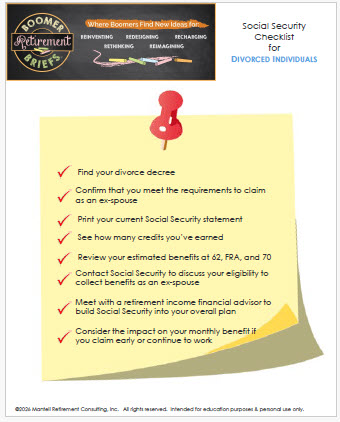
Even if you didn’t apply for ex-spousal benefits when you first applied for Social Security, it is not too late. Read more on Social Security for divorced individuals on SSA.gov. And, get the facts about your options directly from a Social Security agent.
Once you have your Social Security plans underway, check this blog post for other pitfalls to avoid.